
Most agencies don’t lose money on SEO because they can’t sell it. They lose it on delivery. The sale is the easy bit. Then the campaign starts, and suddenly your one SEO hire is juggling six clients, three tools nobody fully uses, and a reporting calendar that eats every Friday.
That’s the problem SEO outsourcing exists to fix.
In this guide I’ll walk through how it works, the five ways to do it, what the numbers look like, and how to pick a partner without getting burned.
If you only have a minute; start small, run a paid pilot, and judge the partner on real work, not promises.
What Is SEO Outsourcing?
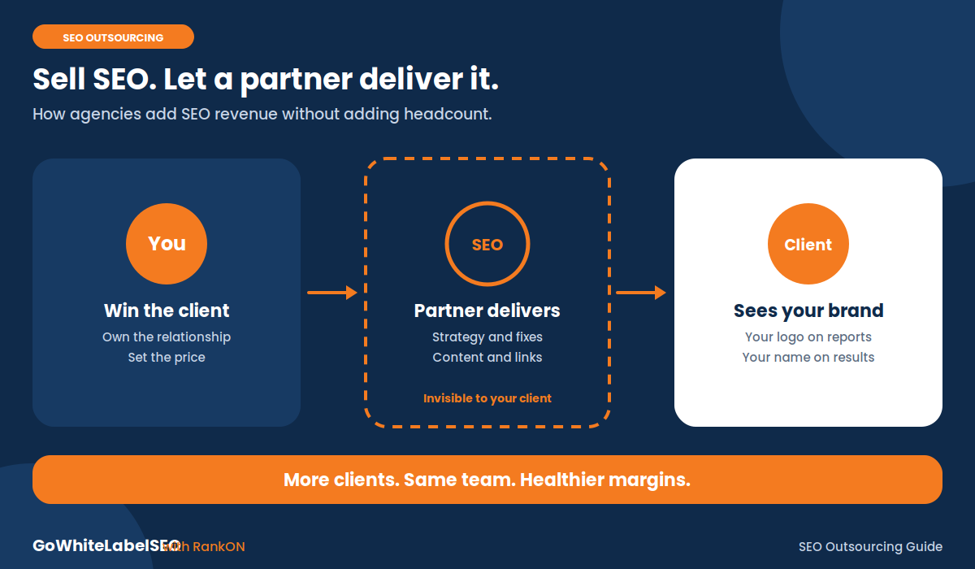
SEO outsourcing means handing the day-to-day SEO work (audits, content, links, citations, reporting) to an external team, while you keep the client relationship, the pricing and the final say on quality.
In the white label version, the partner stays invisible. Your client sees your logo on the reports and your name on the results. If you want the longer definition, we’ve covered it in what white label SEO is and what an outsourced SEO agency actually does.
The model is simple: you win the client, the partner delivers, the client sees your brand.
A useful way to judge the model is to look beyond the list of tasks. What decision is the client trying to make, and what information would help them make it? A partner who produces an audit, article or report should be able to connect the deliverable to that need, rather than simply completing a checklist.
Outsourcing can give an agency room to take on more clients without building every specialist role in-house.
Why Agencies Are Outsourcing SEO
Short answer: In-house SEO is expensive in ways that don’t show up on the first spreadsheet.
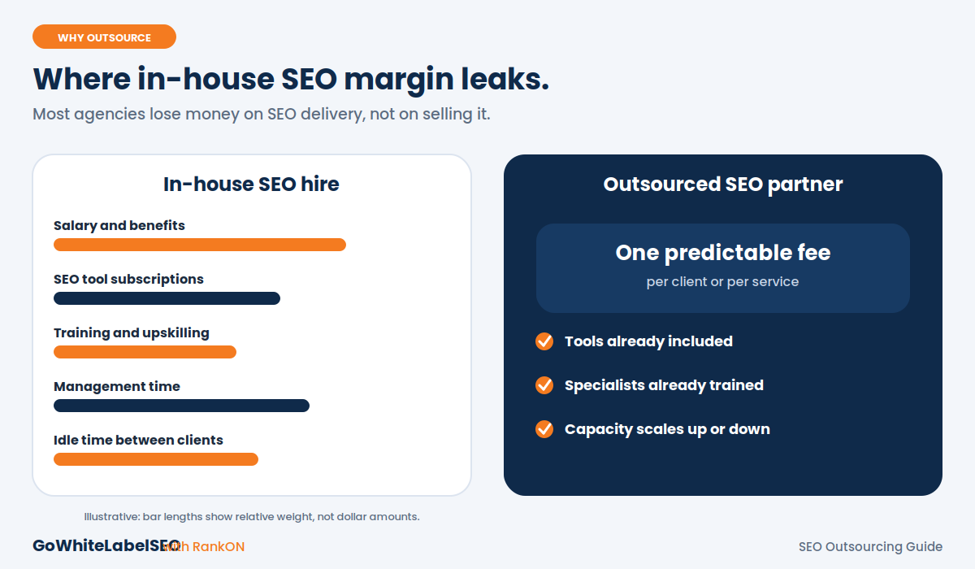
Salary and benefits are the obvious line. Then comes the tool subscriptions, training (SEO changes faster than most courses can keep up with), management time, and the one nobody budgets for: idle time between clients. A specialist you’ve hired still costs you in the month a client churns.
An outsourced partner flips that into one predictable fee per client or per service. The tools are already paid for, the specialists are already trained, and capacity moves up or down with your pipeline.
Outsourcing isn’t automatically cheaper in month one. It’s cheaper once you have more than a couple of clients, or when your workload swings a lot. If you have one client and a quiet pipeline, hiring might still make sense.
5 Ways to Outsourcing SEO
“Outsourcing” covers a lot of ground. The five models agencies usually choose between are:
- Freelancer: High control and low cost, but limited capacity and a single point of failure. If they get sick, your client’s campaign does too.
- Subcontract agency: More hands than a freelancer, but you’re often one of many clients in their queue.
- Offshore team: Scales well and costs less, but quality and communication depend heavily on who runs it.
- White label partner: Strong on scalability, cost and low risk, with slightly less day-to-day control since you’re not managing individuals.
- Hybrid: You keep a small in-house lead and outsource the heavy lifting. Best control, but you carry more cost.
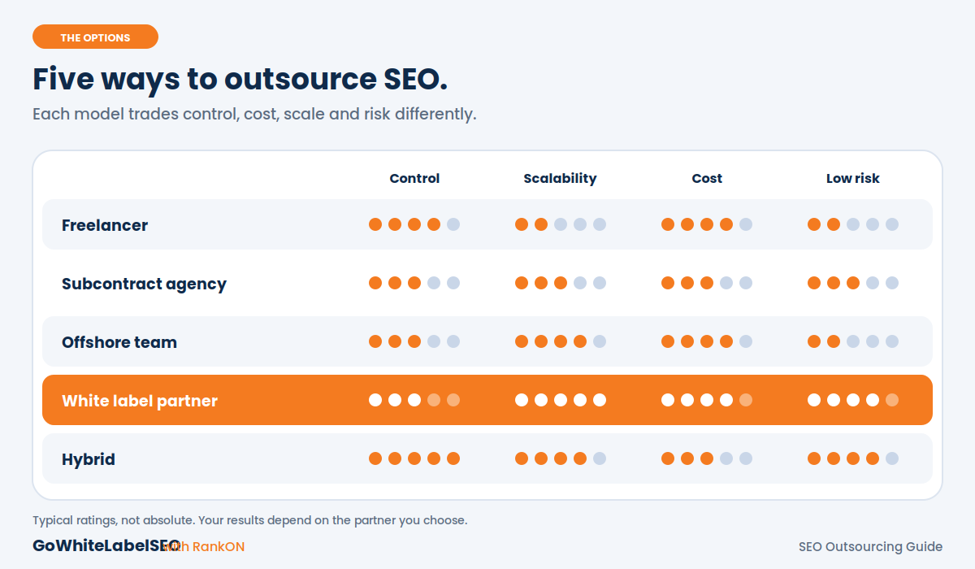
These ratings are typical, not absolute. A brilliant freelancer beats a mediocre white label partner every single time.
What to Outsource and What to Keep
The risk is handing over too much and losing oversight, or keeping every task in-house and gaining little capacity. The right split depends on what your team can evaluate confidently and what the partner can deliver reliably.
A useful rule is to outsource execution where it makes sense, while keeping ownership of the client relationship, strategic decisions and quality standards.
Outsource: Technical audits and fixes, link building and outreach, content production, local citations and profiles, report preparation, routine monitoring.
Keep: The client relationship, pricing and packaging, strategy sign-off, the final quality check, client communication, and your brand and voice.
The final quality check matters because your agency remains accountable to the client. Review whether the work answers the brief, whether claims are supported, whether recommendations are actionable and whether the deliverable reflects the client’s business.
A quick review is useful, but it should not replace specialist review when the work involves technical risk or significant investment.
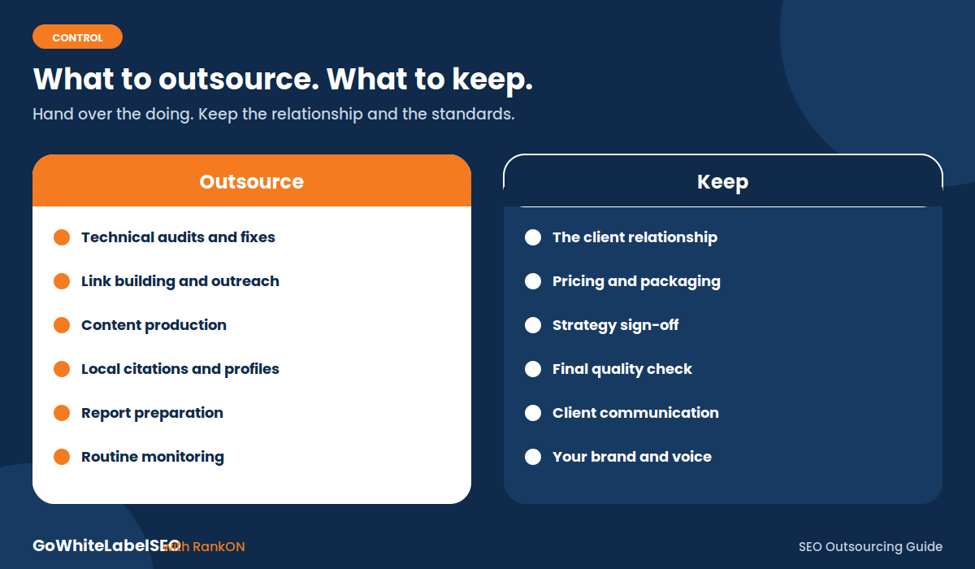
Notice that “final quality check” sits in the keep column. Your partner can build the thing, but your name is on it. Somebody on your side needs to look at it before it goes out the door, even if it’s a fifteen-minute skim.
How to Outsource SEO: A 7-Step Process
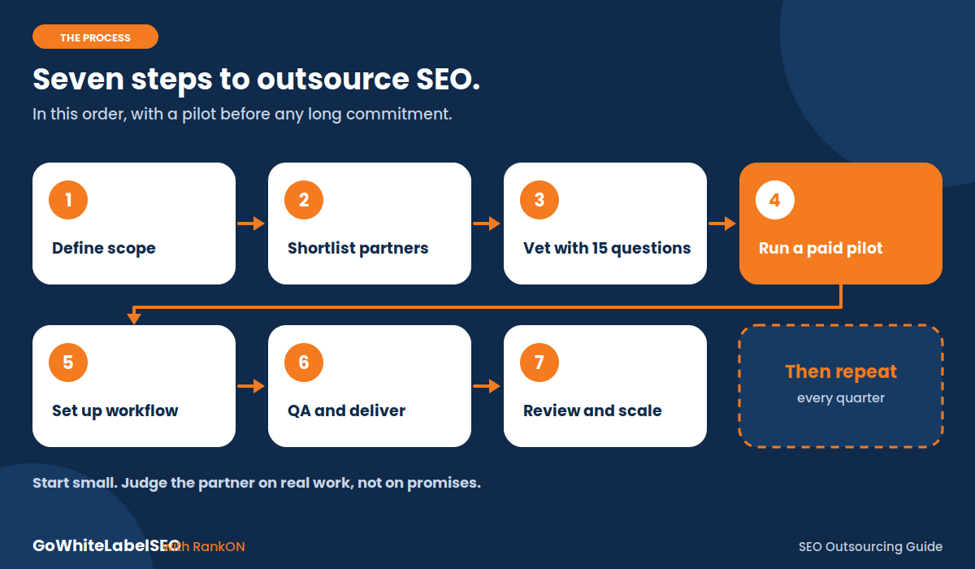
Do these in order. The pilot comes before any long commitment, and that’s the part people skip.
- Define scope: Which services, how many clients, what “good” looks like. Write it down.
- Shortlist partners: Three or four is plenty. More than that and you’ll never decide.
- Vet partners on experience, tools, reporting, security, staffing and how they respond when results or delivery fall short. Ask for examples of work that needed correcting, what changed and how they communicated it. A useful answer should explain the process, not just offer reassurance.
- Run a paid pilot using a real, clearly scoped task. Agree on the brief, deliverables, deadline, review criteria and what evidence or access the partner will need. Choose work that lets you assess quality, not simply speed.
- Set up the workflow. Shared calendar, briefing template, who approves what, who talks to whom.
- Review the deliverable before it reaches the client. Check accuracy, relevance, evidence, implementation details and whether it resolves the original brief. Record revisions so recurring problems can be addressed in the process.
- Review delivery and outcomes before scaling. Look at quality, communication, timeliness, the amount of rework and whether the work helped address the client’s stated objective. Repeat the partner review quarterly, or sooner if quality slips.
Five Risks In Outsourcing SEO (and Five Fixes)
Outsourcing risks are easier to manage when each one has a clear control and an owner. Add these checks to the workflow rather than relying on a contract alone.
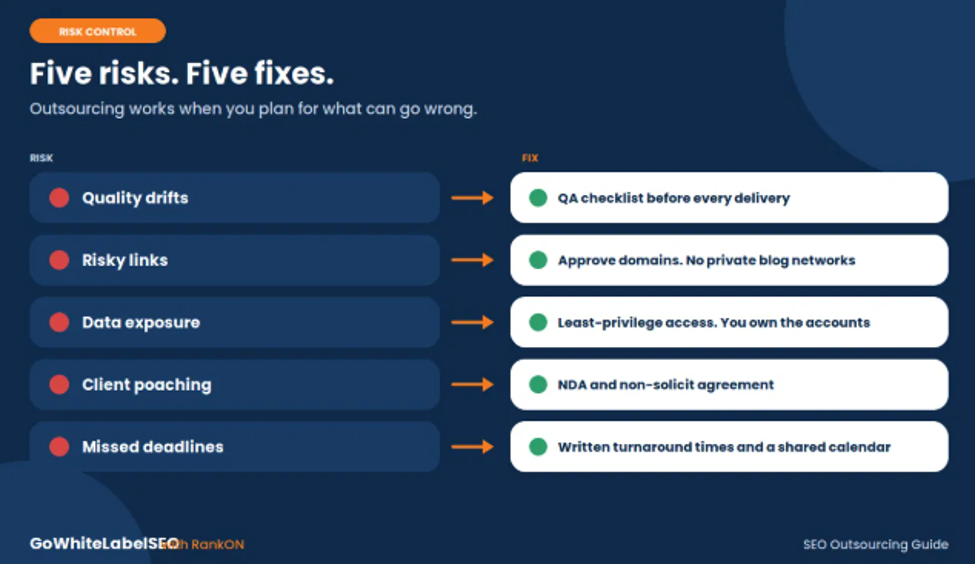
- Quality drifts. Fix: a QA checklist before every delivery.
- Risky links. Fix: approve domains yourself, and no private blog networks. Ever.
- Data exposure. Fix: least-privilege access, and you own the accounts (Search Console, Analytics, hosting, all of it).
- Client poaching. Fix: an NDA and a non-solicit agreement.
- Missed deadlines. Fix: written turnaround times and a shared calendar.
The “you own the accounts” one matters more than it looks. If the partner owns the Search Console property and the relationship sours, you’re negotiating for your own client’s data. Don’t be in that position.
Is SEO Outsourcing Right for Your Agency?
It probably is if you’re adding SEO clients faster than you can hire, your delivery team is stretched, or you want to offer SEO without building a department. It’s probably not if you have a single client, no process of your own, or you can’t spare even a little time for QA.
If you’re leaning yes, the cleanest next step is a small paid pilot with one client and one service. Our white label SEO services are built to plug in that way, whether that’s a full campaign or a single piece like technical audits or link building.
You can also check the packages to see how pricing works before you commit.
Final Thoughts
SEO outsourcing isn’t magic, and it isn’t a shortcut. It’s a way of separating selling SEO from delivering it, so your team can grow without your margins quietly shrinking. Pick the right model, keep the standards in your hands, pilot before you commit, and review every quarter.
If you’d like to try it with one client first, let’s talk.
FAQs About SEO Outsourcing
What is SEO outsourcing?
Hiring an external team to do SEO work for you or your clients, such as audits, content, links and reporting, while you keep the client relationship.
Is SEO outsourcing worth it for agencies?
Usually, once you have several clients or an uneven workload. You avoid salaries, tools and training, and you pay one predictable fee instead.
What’s the difference between SEO outsourcing and white label SEO?
White label SEO is a type of outsourcing where the work is delivered under your brand and the partner stays hidden from your client.
What should I never outsource?
The client relationship, pricing, strategy sign-off and the final quality check.
How many SEO clients can one agency run through a partner?
There’s no fixed cap. It depends on the partner’s capacity and your own QA bandwidth, so ask about concurrent campaigns up front.